M-Bus, Modbus, BACnet, and LoRaWAN solve different smart building integration problems. The right choice depends on whether the project is focused on utility metering, equipment control, building automation, wireless retrofit, or long-range sensor connectivity.
Short Answer for Project Teams
Use M-Bus when the priority is utility metering. Use Modbus when the priority is industrial equipment and controller integration. Use BACnet when the data must be consumed by a building management system. Use LoRaWAN when long-range, low-power wireless connectivity is needed.
Practical protocol comparison for smart-building projects Protocol Best-fit role Design question to answer M-Bus Wired utility-meter collection How many meters, records, cable segments, and read cycles must the master support? Modbus Industrial devices, meters, and controllers Are the register map, data type, word order, scale, unit, and polling limits documented? BACnet BMS objects, alarms, trends, and supervisory integration Which objects, units, status flags, priorities, and network identifiers will be governed? LoRaWAN Low-power wireless meters and sensors Do coverage, payload, battery, duty-cycle, downlink, and key-ownership constraints fit the use case?M-Bus for Utility Metering
M-Bus is widely used for water meters, BTU meters, gas meters, and heat cost allocation. It is well suited for collecting many meter readings through a master gateway and feeding AMR or billing platforms. For tenant billing, M-Bus remains one of the most practical protocols because it was designed around metering use cases.
Modbus for Industrial and Equipment Data
Modbus is common in energy meters, controllers, HVAC equipment, PLCs, and industrial automation panels. It is simple, reliable, and widely supported. In mixed buildings, Modbus often acts as the bridge between field equipment and supervisory systems.
BACnet for BMS Integration
BACnet is commonly used by building management systems to monitor HVAC, lighting, chilled water, and plant-room equipment. When facility teams want metering or equipment values visible inside the BMS, protocol converters are often used to expose M-Bus or Modbus data as BACnet objects.
LoRaWAN for Wireless Retrofit and Remote Sensors
LoRaWAN is useful when wired cabling is expensive, disruptive, or physically difficult. It is a strong fit for wireless leak sensors, indoor air quality sensors, pulse readers, level monitoring, and remote metering points. The tradeoff is that LoRaWAN should be designed around low-power telemetry rather than high-frequency control.
Where Protocol Converters Fit
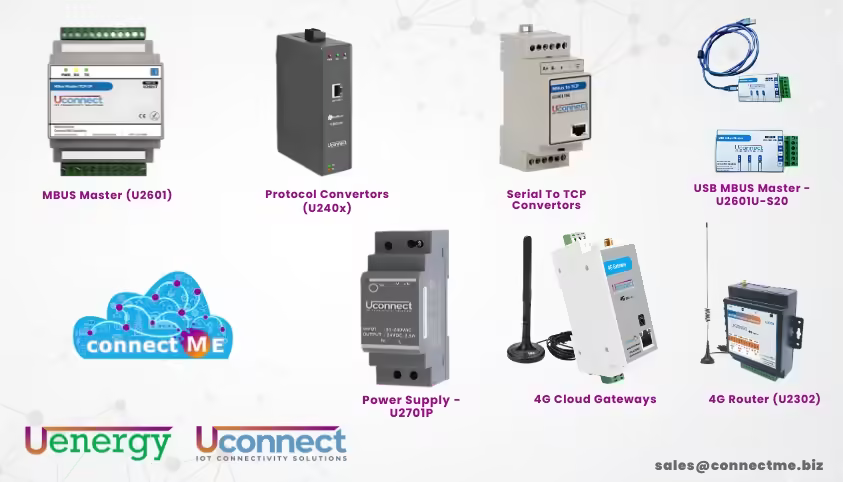
Most real projects need more than one protocol. A chilled water plant may use Modbus equipment, M-Bus BTU meters, BACnet BMS integration, and LoRaWAN sensors. UCONNECT protocol converters help bridge these layers so each system receives the data it needs without replacing suitable working infrastructure. Review the ConnectME protocol converter range for available interfaces.
Capacity and Polling Are Part of Protocol Selection
A protocol name does not prove that a network can meet the required update time. Project teams should calculate the device count, points or records per device, request and response time, retries, gateway processing, and operational headroom. The same principle applies to wireless systems: expected reporting interval, payload size, reception quality, and battery budget belong in the architecture decision.
Commission the Meaning, Not Only the Connection
A successful response is only the first test. Compare local and downstream values for identity, units, scale, sign, timestamps, totalizer behavior, and quality status. Then witness a communication failure and recovery. The meter protocol interoperability matrix and RS-485 Modbus network checklist provide field-ready review points.
Decision Guide
- Metering and billing: choose M-Bus or DLMS-ready metering with AMR/MDMS integration.
- Plant rooms and controllers: choose Modbus RTU/TCP where industrial equipment support is required.
- BMS visibility: expose validated field data through BACnet where facility teams need central monitoring.
- Wireless sensors: choose LoRaWAN for long battery life, long range, and retrofit deployment.
- Mixed environments: use gateways and converters instead of forcing one protocol across the whole building.
Conclusion
Protocol selection is not about choosing one winner. It is about matching each protocol to the job it performs best, then using gateways and converters to create one reliable operating layer for the building.
Technical reference: consult the current Modbus Organization specifications, the selected manufacturers' documentation, and the approved project design before configuration or commissioning.
A strong smart building architecture does not force every device into one protocol. It uses the right protocol at the field level and the right gateway strategy at the system level.
ConnectME Integration Team