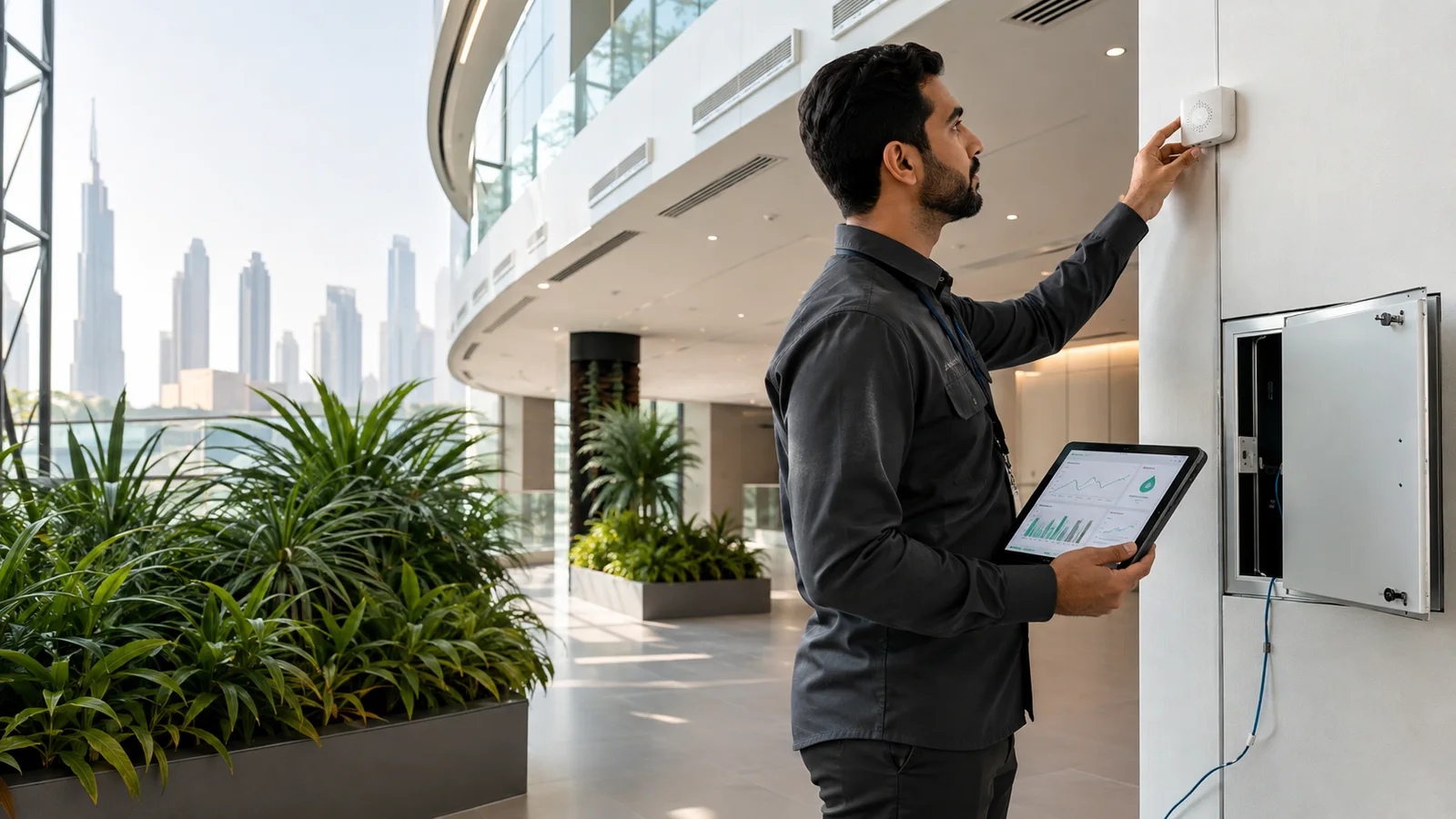
A useful environmental monitoring system for a Dubai building connects each air, water or leak sensor to a defined location, acceptable range, response owner and maintenance record. Installing more sensors does not by itself improve environmental performance. The value comes from knowing whether the reading is trustworthy and what the operations team should do next.
The first Dubai Environment Conference and Exhibition, held on 7-8 September 2026, placed natural resources and environmental artificial intelligence among six programme themes. The official agenda linked environmental AI with better data collection, monitoring and compliance tracking. For building teams, that makes the quality of field data a practical starting point.
Source context: reviewed on 7 September 2026 using the Dubai Media Office report on the inaugural Dubai Environment Conference and Exhibition and its programme announcement. The event themes are not a new building regulation. The system-design recommendations below are ConnectME's operational guidance and must be checked against project requirements and applicable standards.
What should a building monitor?
Start with a building risk or operating question. Indoor air-quality monitoring may focus on ventilation performance and occupied-space conditions. Water monitoring may focus on storage, consumption or abnormal flow. Leak detection may protect plant rooms, data rooms, kitchens or concealed service areas. Each objective needs its own sensor location, interval and response rule.
1. Write the response before choosing the sensor
For every planned point, describe the condition that matters and the action it should trigger. “Monitor CO2” is incomplete. “Notify the facility supervisor when an occupied meeting room remains above the agreed project threshold for 15 minutes, then check occupancy and ventilation status” is an operating rule.
- Environmental condition or risk being observed.
- Location and zone represented by the reading.
- Expected range, persistence time and severity levels.
- Named first responder and escalation path.
- Evidence required to close the event.
2. Build a location model that people can understand
A sensor ID should resolve to building, floor, room or plant area, served system and physical position. Add installation height and distance from doors, diffusers, direct sunlight or local heat sources where they can affect the reading. Link the sensor to the relevant air-handling unit, water zone or isolation valve.
Use one asset ID in drawings, the BMS, the IoT platform and maintenance records. A dashboard label such as “IAQ-27” is not useful during an incident unless the technician can find it quickly.
3. Commission the reading in context
Commissioning should prove more than connectivity. Compare the installed device with a suitable reference or known condition, confirm units and timestamps, and observe how the reading responds when occupancy, ventilation or water presence changes. Record firmware, configuration, communication quality and the date of the test.
For wireless devices, test the actual installed location with doors, ceilings and equipment in their normal state. A strong bench signal does not prove reliable operation above a finished ceiling or behind a plant-room enclosure.
4. Define a small data contract
Every platform connection should document the point name, asset ID, unit, expected interval, timestamp convention, valid range and missing-data rule. Keep raw readings available. If the application calculates an index or status, record the formula or vendor method and its version.
- Do not silently replace missing values with zero.
- Flag stale values instead of presenting the last reading as current.
- Preserve sensor-health, battery and communication information.
- Record who changed a threshold or disabled an alert.
- Use consistent time zones across sensors, gateways and the BMS.
5. Separate environmental events from device faults
A high reading and a failed sensor are different problems. The system should distinguish an environmental threshold event, a communication loss, a low battery, a flatline and an out-of-range device value. Sending all five to one generic alarm queue makes them harder to resolve.
Review alert performance monthly: events raised, acknowledged, investigated and closed; recurring zones; false alarms; offline devices; and average closure time. The review should lead to a maintenance or controls action, not only a report.
6. Connect air, water and equipment context carefully
Environmental readings become more useful when paired with relevant operating data. An elevated CO2 reading may need occupancy and ventilation context. Temperature and humidity may need fan status and setpoint history. Abnormal water flow may need valve position, tenancy and meter history. A BMS integration can provide this context, but only when point names, units and timestamps align.
7. Protect access and privacy
Environmental systems may reveal occupancy patterns and building operations. Limit access by role, remove default credentials, document remote support, and separate sensor networks from unrelated corporate traffic. Collect the least personal data needed for the operational purpose. Transfer platform ownership and administrator accounts to the building owner at handover.
A practical starter scope
- Select one occupied zone and one high-consequence water area.
- Install a small number of representative points with documented locations.
- Connect them to the existing BMS or IoT platform through an owned gateway.
- Run a commissioning test covering normal, threshold, offline and recovery states.
- Operate the response workflow for 30 days and review every event.
- Correct placement, thresholds and ownership before scaling to more zones.
Questions buyers should ask
- Which exact space or risk does each sensor represent?
- What reference, calibration or functional test supports the reading?
- How does the platform identify stale, missing or implausible data?
- Who receives each alert, and what proves that it was resolved?
- Can the owner export the readings, configurations and event history?
- Who maintains batteries, firmware, gateways and replacement stock?
Where ConnectME fits
ConnectME supplies and integrates indoor air-quality sensors, temperature and humidity sensors, water-leak detection, LoRaWAN and other IoT gateways, BMS connectivity, dashboards and remote monitoring. The project scope can include sensor placement review, point schedules, commissioning, alert workflows and maintenance ownership.
Next step: choose two representative spaces and write the operating response expected from each sensor before selecting hardware. Contact ConnectME to turn that response plan into a practical pilot and field acceptance checklist.
Environmental data becomes operational evidence when every reading has a location, a quality check and an owner.
ConnectME Smart Building Team