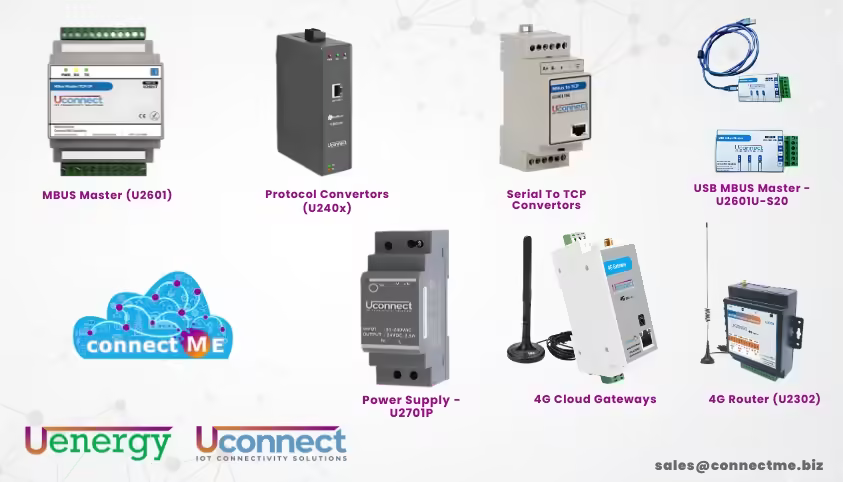
In the world of industrial automation, integrating devices and systems that communicate using different protocols can be a daunting task. Various protocols such as Modbus, M-Bus, Bacnet, and LoRaWAN dominate the landscape. Protocol converters play a crucial role in ensuring seamless communication across disparate systems.
What are Protocol Converters?
Protocol converters, or gateways, act as intermediaries between different communication protocols, translating data from one protocol format to another.
Key Protocol Converters and Their Applications
1. Modbus to M-Bus Conversion
Essential for systems where Modbus devices need to interact with M-Bus meters, commonly used in energy or water meter integration with SCADA systems and smart building management.
2. Bacnet to M-Bus Conversion
Enables seamless communication between building automation systems and metering systems, vital for optimizing energy management in smart buildings.
3. M-Bus to Bacnet Conversion
Allows data from electricity, water, and gas meters to be sent to a Bacnet-compatible building automation system for centralized monitoring.
4. M-Bus to LoRaWAN Conversion
Offers innovative solutions for applications requiring long-range communication for metering data, with energy-efficient communication ideal for battery-powered devices.
5. Modbus to LoRaWAN Conversion
Bridges traditional industrial systems with modern IoT devices, useful in smart agriculture and industrial monitoring applications.
Uconnect Protocol Convertors
UCONNECT offers a comprehensive range including: U2301TM, U2302, U2310A, U2320, U2320A, U2321-I6, U2401, U2402-S125, U2402-S250, U2403-S125, U2403-S250, U2404, U2405, U2406, U2501, U2601-S125, U2601-S250, U2601M-S250, U2601T-TCP, and U2701P.
As industrial IoT continues to evolve, the role of protocol converters in improving operational efficiency, reducing costs, and enhancing scalability will only become more significant.
Protocol converters are revolutionizing industrial automation by allowing seamless communication between diverse systems. By bridging communication gaps between legacy and modern devices, we can unlock efficiencies that were previously unattainable, significantly reducing downtime and improving overall system interoperability.
Kothandapani (Koths), IIoT Specialist at ConnectME Solutions