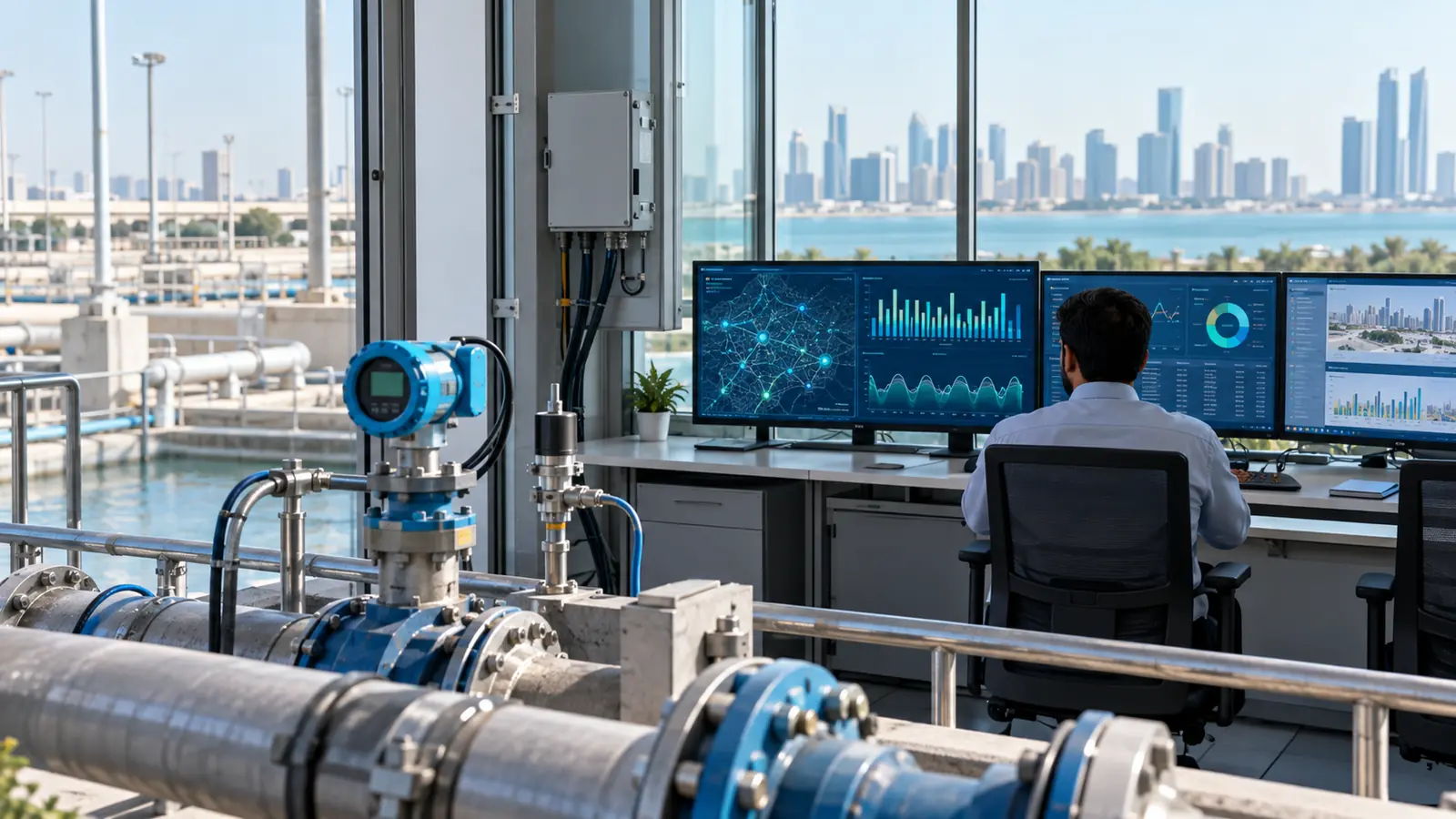
Water resilience at building level depends on more than installing a smart meter. Owners need a trusted meter register, time-based consumption, pressure and operating context, clear leak-response rules, and evidence that every alert or correction was handled. Those foundations make water data useful for operations, investment and reporting.
The inaugural Abu Dhabi Water & Power Week (ADWPW) - Special Water Edition 2026 is scheduled for 8-10 December 2026 at ADNEC Centre Abu Dhabi. The Department of Energy - Abu Dhabi announced that the programme will bring together policy, finance, technology and utility stakeholders to discuss practical water-resilience solutions.
Source context: event dates, venue and programme themes are from the Emirates News Agency announcement published 17 September 2026. The building-level recommendations below are ConnectME's analysis. They are not Department of Energy guidance, event endorsement, or a claim that any ConnectME product is approved by the organisers.
What the announcement establishes
According to the official announcement, ADWPW will coincide with the United Nations Water Conference 2026 and will include policy and regulation, finance and investment, and technology and innovation summits. The stated aim is to advance practical solutions that strengthen water resilience and support sustainable economic development.
The announcement does not prescribe a building-meter specification. It does, however, sharpen a useful question for asset owners: can the current water-data chain support a decision when supply, cost, leakage or performance becomes urgent?
Five records a resilient building needs
- Meter identity: model, serial number, location, served zone, unit, multiplier and communication path.
- Time-based consumption: interval or daily readings that reveal baseload, peaks and changes hidden by a monthly total.
- Operating context: occupancy, irrigation schedules, tank levels, pump operation, pressure and known maintenance activity where relevant.
- Data quality: gaps, repeated values, rollovers, battery state, communication health and documented corrections.
- Response evidence: who received an alert, what was inspected, what action was taken and when the event was closed.
A dashboard that omits these records can display attractive charts while leaving the operations team unable to explain a high-use period or prove that a leak alarm led to action.
Start with a water balance, not a sensor catalogue
A practical review compares the incoming meter with meaningful downstream boundaries. Those boundaries might include towers, tenant groups, cooling make-up, irrigation, kitchens, laundries or other major uses. The purpose is not to meter every pipe. It is to locate unexplained consumption at the level where someone can investigate it.
The balance should use aligned time periods and known units. If the incoming meter closes at midnight while a sub-meter report closes at a different time, an apparent loss may be a timing difference rather than water leaving the system.
Leak detection requires an operating workflow
Continuous flow, an abnormal overnight baseline or a sudden increase can indicate a leak, but each can also reflect legitimate operation. Alert rules therefore need site context, persistence periods and ownership. A critical plant-room event may require an immediate call and isolation procedure, while a small tenant-zone anomaly may begin with verification.
Where automatic shutoff is considered, the design must define authority, fail-safe behaviour, feedback, manual override and recovery. A software command should never replace the approved engineering and safety process.
Make water projects measurable before funding them
The finance theme in the ADWPW programme is relevant to building teams because a water project is easier to evaluate when the starting point and verification method are clear. A proposal should state the boundary, baseline period, expected operational change, measurement method and factors that may require adjustment.
Useful project evidence can include:
- validated volume before and after the intervention;
- changes in overnight baseload or unexplained use;
- alert-to-acknowledgement and alert-to-closure time;
- meter and gateway availability;
- confirmed leak events and avoided repeat failures;
- commissioning and calibration records.
Questions for owners, consultants and BMS providers
- Which physical water boundary does each point represent?
- Can installed meters provide the required interval and status data?
- How will M-Bus, Modbus, LoRaWAN, pulse and API data be normalized?
- Who owns missing readings, alarm thresholds and event closure?
- What happens locally if cloud or network connectivity is unavailable?
- How will data, corrections and configuration changes remain traceable?
Where ConnectME fits
ConnectME supports smart water metering, water-leak detection, LoRaWAN and wired meter connectivity, AMR, meter data validation, BMS integration and portfolio dashboards. A sensible first scope is to map the existing meter estate and one high-consequence water workflow before selecting additional hardware.
What happens next
ADWPW has not yet taken place. ConnectME will review the published outcomes after the event and update this analysis if the organisers release new policy, technical or investment guidance relevant to building water data.