For a building owner, an investable efficiency project starts with a measured baseline and a plan to verify the result. Dubai Electricity and Water Authority's October announcement of the World Green Economy Summit (WGES) 2026 agenda puts energy infrastructure, business transition, water, finance and governance in one conversation. ConnectME's reading is that asset-level proposals should connect those themes to reliable utility evidence.
DEWA's 6 October 2026 announcement says the summit is scheduled for 21-22 October 2026 at Dubai World Trade Centre. Its four thematic pillars are Energy Technology & Infrastructure, Business Strategy & Transition, Water & Food Security, and Finance, with AI, governance and system enablers running across them. The summit has not yet taken place, and the announcement does not set a new building-metering rule.
What boards and investors need before approving work
A capital request for cooling, water or electricity efficiency should name the asset boundary, baseline period, proposed intervention, expected operational change and verification method. The owner should know whether claimed savings come from lower consumption, a different tariff, changes in occupancy or a change in the energy supply mix. Without that separation, even a well-intentioned dashboard can mislead a funding decision.
Three checks for an investment-ready project
- Measurement: confirm the correct meters serve the correct plant, tenant or building boundary; record units, multipliers and calibration status.
- Data quality: quantify gaps, estimates, communication outages and abnormal readings before calculating a baseline.
- Verification: agree who will compare post-project performance with the baseline and which operating changes require an adjustment.
These checks apply whether the project concerns a chiller, tenant billing, leak response or portfolio reporting. AI may help analyse patterns, but it cannot repair an incorrect meter map or an undocumented estimate.
A practical next step for GCC portfolios
Select one high-cost or high-risk use case and review the chain from field measurement to management report. ConnectME supports metering and connectivity, AMR collection, and energy data dashboards. The first deliverable should be a verified baseline and decision owner, not a promise of savings without site evidence.
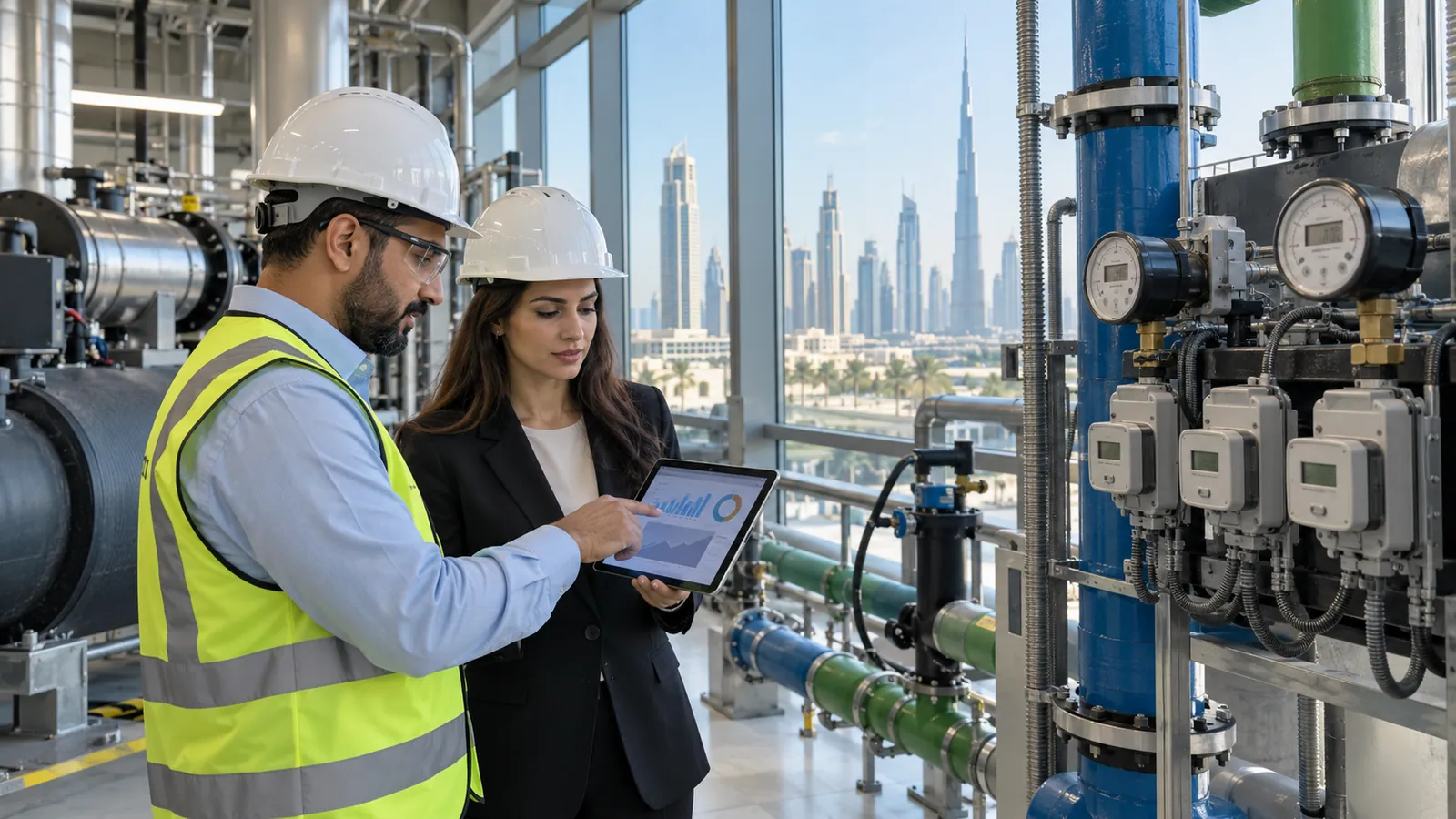
Source context: summit dates and themes are from DEWA's announcement of 6 October 2026. The procurement and data-quality recommendations are ConnectME analysis published 13 October 2026, not DEWA guidance or a WGES endorsement. The image is a generated illustration, not an event photograph.